
Dealmaker and Dealbreaker: a practical guide to choosing the right people in your life
Proper time management is essential to be able to work calmly and grow both professionally and humanly: only by optimizing different activities will you be able to banish anxiety and worries, focus on your career, and increase your confidence in yourself and your abilities.
arrow_forwardRead the postAccording to my experience, the sentence “I don’t have time” is uttered, in one day, more times than a child utters the word mother in his or her first years of life.
Proper time management is essential to be able to work with serenity and grow both professionally and humanly: only by optimizing different activities will one be able to drive away anxiety and worries, focus on one’s career, and increase confidence in oneself and one’s abilities.
However, it is necessary to start from a premise: time, which is the most democratic resource there is, cannot be managed. Every day we are given a 24-hour credit, and we have to choose what to do with it. So we can only manage ourselves as best we can in those 24 hours.
Speaking of time management, there are several models to facilitate time management. Let’s find out three main ones.
Being busy does not necessarily mean being productive: you can spend hours and hours in the office and still fail to complete your tasks on time. The consequence? Increased anxiety and stress, feelings that should be experienced at work as little as possible.
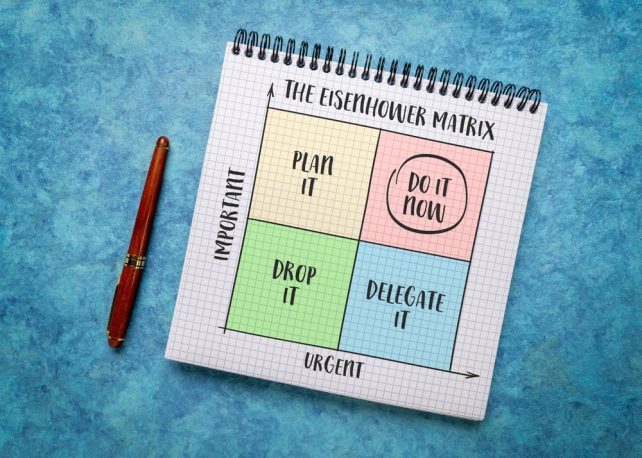
The problem of what we commonly call “wasted time” is, oftentimes, related to poor prioritization. In fact, we often focus too much on urgency (including those of others), neglecting the level of importance of each of the tasks marked on our to do list. Instead, by learning to distinguish between tasks by considering both their urgency and importazai, it is possible to define those activities that are prioritized and on which to focus the necessary time and energy first.The Eisenhower Matrix helps to make this distinction, improving priority management.
“I have two kinds of problems: the urgent ones and the important ones. The urgent are not important, and the important are never urgent,” said Dwight D. Eisenhower, 34th President of the United States, known for his high productivity and organization, after whom this time management model is named. The Eisenhower Matrix is a simple decision-making tool that helps distinguish between important, unimportant, urgent and non-urgent tasks. The matrix divides tasks into four boxes that establish those that are prioritized, on which to focus, and those to be delegated or eliminated. By adopting this tool, one can thus select the less urgent and important tasks from one’s to-do list, which one can delegate or even avoid doing.
The Eisenhower Matrix can thus prove to be a valuable ally for those who realize that they are particularly scattered at work, perhaps because they devote themselves solely to urgent tasks instead of focusing on the tasks that need to be completed, but also for those who know themselves to be busy but at the same time have the perception that their work has limited impact. Similarly, you may adopt the Eisenhower Matrix if you are not making progress on long-term goals, if you procrastinate on important tasks, if you struggle to say no when colleagues beg you to buffer their urgencies, or if you have difficulty delegating tasks.

Another effective method for time management consists of the so-called Pomodoro® Technique. This time management model is based on 25-minute sessions of concentrated work, interrupted by 5-minute breaks. After four consecutive work sessions, longer breaks can then be taken, typically ranging from 15 to 30 minutes. Each work session is called a “tomato,” after the vegetable of the same name. In fact, it was an Italian entrepreneur, Francesco Cirillo, who invented the Pomodoro® Technique in the late 1980s, when he was a university student and used a tomato-shaped kitchen timer to organize his study schedule. At first he experimented with different sessions, starting with two-minute intervals and extending them up to an hour; soon, however, he realized that these sessions became too long to stay focused on a task and therefore settled on 25 minutes, indicating this as the optimal time for his needs.
Building on his own experience, Cirillo realized that time could be turned into an ally rather than a source of anxiety. How? Simple: the Pomodoro® Technique trains people to focus better on tasks by limiting the amount of time available for a specific task and providing restorative breaks from the effort. The method also helps overcome the tendency to procrastinate or multitask, two factors known to undermine productivity.
The Pomodoro® Technique can also help people develop more efficient work habits: an effective time management method allows people to achieve more in less time, resulting in experiencing a greater sense of accomplishment, both personal and professional. The Pomodoro® Technique is divided into 5 incremental processes that help develop a conscious and productive relationship with time:

A third tool for improving time management is the Gantt Chart, a useful template particularly for project managers that illustrates the work to be completed in a given period of time by relating it to the time planned to accomplish that specific task. Thus, a Gantt chart can include task start and end dates, milestones, how tasks are connected, and the people to whom they are assigned.
Project managers use the Gantt chart for three main reasons:
By participating in our time management training program for freelancers, entrepreneurs, sales, HR and business area managers, and work teams, you will be able to learn more about how you manage your time and what techniques and tools are best suited to improve your time management, thereby achieving more effective results with less wasted energy and greater professional and personal satisfaction.

Per avere maggiori dettagli sul mio metodo e su come puoi lavorare con GCA, utilizzate il modulo sottostante per contattarmi e ti risponderò al più presto per prenotare una appuntamento!
arrow_forward